Charles Bukowski: A Literature of Survival, Truth, and Unvarnished Beauty
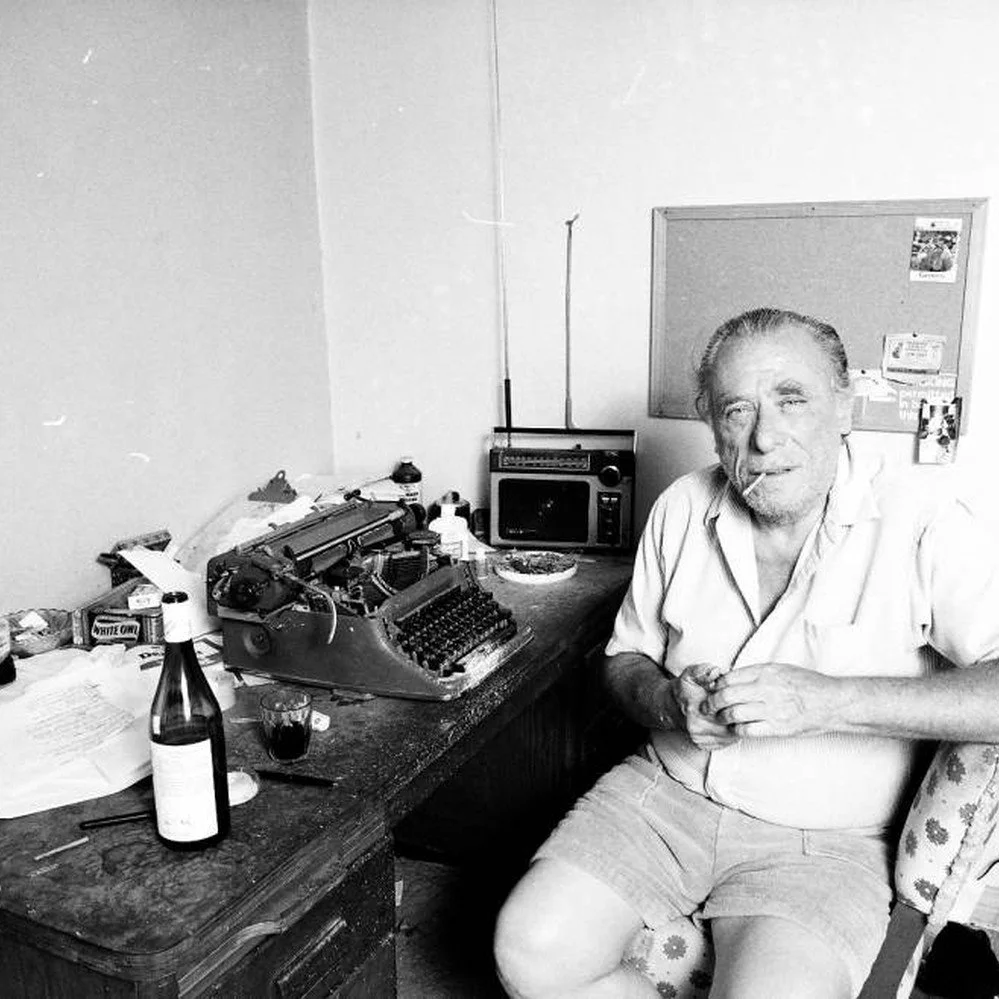
There are writers who refine reality into elegance, and then there are writers who strip it bare. Charles Bukowski belongs to the latter tradition, standing as one of the most uncompromising voices in twentieth century literature. His work does not seek to comfort. It confronts. It unsettles. And in doing so, it reveals a strange and enduring beauty hidden beneath the surface of ordinary suffering.
Born on August 16, 1920, in Andernach, Germany, Bukowski emigrated with his family to the United States as a child, settling in Los Angeles. It is here, in the vast sprawl of a city defined by illusion and aspiration, that Bukowski would forge his literary identity. Yet his Los Angeles was not the glamorous metropolis of cinema. It was a landscape of rented rooms, factories, bars, racetracks, and loneliness. It was a city experienced from the margins, and it is from this vantage point that his voice emerges.
Bukowski’s early life was marked by instability and violence. His father, an authoritarian and often abusive figure, imposed a harsh domestic environment that left deep psychological scars. At school, Bukowski found little refuge. He was bullied, isolated, and alienated from his peers. These formative experiences instilled in him a profound distrust of authority and a deep identification with society’s outsiders.
Writing became both an escape and an act of defiance. Influenced by authors such as John Fante, Bukowski began composing stories and poems at a young age. Yet his path into literature was anything but linear. After leaving college, he drifted through a series of menial jobs, from warehouse work to truck driving. These years, often marked by poverty and heavy drinking, would later become the raw material of his fiction. Bukowski did not write about imagined lives. He wrote about survival.
Bukowski’s early literary career was defined by rejection. His submissions to mainstream magazines were frequently dismissed, and for a time he abandoned writing altogether. Yet in the 1960s, he reemerged within the underground press, where his unapologetic style found a receptive audience.
His breakthrough came with Post Office in 1971, a semi autobiographical novel chronicling his years as a postal worker. Written in a direct, unadorned prose, the novel introduced readers to Henry Chinaski, Bukowski’s fictional alter ego. Chinaski would become the central figure in much of Bukowski’s work, a hard drinking, disillusioned writer navigating the absurdities of modern life.
Subsequent novels such as Factotum, Women, and Ham on Rye expanded this world, creating a loose autobiographical cycle that blurred the boundaries between fiction and lived experience. Bukowski’s Los Angeles is not a place of dreams fulfilled, but of endurance, compromise, and fleeting moments of grace.
At the core of Bukowski’s writing lies an uncompromising commitment to truth. Not truth as abstraction, but truth as lived experience. His work refuses sentimentality. It rejects the polished narratives that often dominate literature. Instead, it offers a blunt and sometimes brutal depiction of existence.
Bukowski writes about alcoholism, poverty, failure, and loneliness with a clarity that can be uncomfortable. Yet it is precisely this honesty that gives his work its power. He does not elevate his characters into heroes. He allows them to remain flawed, contradictory, and painfully human.
In a cultural landscape often defined by performance and illusion, Bukowski’s refusal to disguise reality becomes a radical act. His writing insists that truth, however harsh, is more meaningful than comfort.
And yet, to reduce Bukowski to mere brutality is to misunderstand him. Beneath the surface of his work lies a persistent search for beauty. Not the idealized beauty of romance or artifice, but a fragile, fleeting beauty found in ordinary moments.
A conversation in a bar. A horse race on a hot afternoon. A brief connection between strangers. These moments, often overlooked, become sites of quiet revelation. Bukowski’s gift lies in his ability to locate meaning within the mundane, to uncover a kind of poetry within the everyday.
This vision aligns closely with a deeper philosophical impulse: the idea that beauty is not something separate from suffering, but something that emerges through it. Bukowski does not deny the ugliness of life. He moves through it, and in doing so, reveals its hidden textures.
Bukowski’s work is also a sustained meditation on freedom. His characters exist outside the structures of conventional success. They reject stable careers, social respectability, and material ambition. Instead, they pursue a form of freedom rooted in authenticity.
This freedom is not glamorous. It is often precarious, lonely, and self destructive. Yet it represents a refusal to conform to societal norms that Bukowski saw as inherently restrictive. His writing champions the individual voice, however flawed, against the pressures of conformity.
In this sense, Bukowski’s literature becomes a form of resistance. It challenges the reader to question what constitutes a meaningful life. Is it security, status, and recognition, or is it the ability to live truthfully, even at the cost of comfort?
Love in Bukowski’s work is never simple. It is marked by longing, frustration, and often failure. Relationships are transient, fraught with misunderstanding and emotional volatility. Yet they are also deeply human.
Bukowski does not present love as redemption. Instead, he portrays it as another arena in which the complexities of existence play out. Desire and disappointment coexist. Intimacy is both sought and resisted.
This unvarnished depiction challenges conventional narratives of romance, offering instead a more nuanced understanding of human connection. Love, in Bukowski’s world, is neither idealized nor dismissed. It is lived, with all its contradictions intact.
Bukowski’s style is deceptively simple. His sentences are short, direct, and unadorned. There is little interest in elaborate metaphor or stylistic flourish. Yet this simplicity is deliberate. It reflects a broader philosophical commitment to clarity and immediacy.
By stripping away ornamentation, Bukowski brings the reader closer to the raw experience of his characters. The language does not mediate reality. It delivers it. This approach aligns him with the tradition of Dirty Realism, a movement characterized by its focus on ordinary lives and its rejection of literary excess.
By the time of his death in 1994, Bukowski had achieved a level of recognition that once seemed unlikely. His work, once confined to the underground, found a global audience. Today, he remains a defining figure in contemporary literature, influencing writers across genres and generations.
His legacy lies not only in his subject matter, but in his approach. Bukowski expanded the boundaries of what literature could encompass. He gave voice to those often excluded from literary representation, transforming the overlooked and the marginalized into subjects worthy of serious attention.
In doing so, he reshaped the landscape of modern writing.
For readers of The Deep Dive Society, Bukowski offers something essential. His work embodies the very values that sustain meaningful engagement with art: truth, beauty, freedom, and love. Not as abstract ideals, but as lived experiences.
Bukowski reminds us that art does not need to be refined to be profound. It does not need to be comfortable to be meaningful. Sometimes, it is in the raw, unfiltered expression of life that we find the deepest insights.
In a world increasingly defined by surface and speed, Bukowski’s writing asks us to look again. To sit with discomfort. To recognise the extraordinary within the ordinary.
And perhaps most importantly, to accept that even in the most broken corners of existence, there is still something worth seeing.
This video captures Charles Bukowski reading his own poetry aloud in a live setting, offering a rare, unfiltered glimpse into his voice, rhythm, and personality. Rather than polished literary performance, Bukowski delivers his poems in a raw, conversational tone, blending humour, bitterness, and honesty.
The readings revolve around everyday experiences, drinking, loneliness, relationships, failure, and the monotony of working life, presented with a stark realism that rejects romanticised ideas of art and success. His delivery often shifts between deadpan humour and quiet intensity, revealing both cynicism and vulnerability.
What makes the video compelling is not just the poetry itself, but the presence of Bukowski as a performer. His pauses, laughter, and offhand remarks blur the line between poet and persona, reinforcing his image as an outsider figure who writes from the margins of society.
Overall, the video is less a formal reading and more an intimate encounter with Bukowski’s worldview, one grounded in grit, survival, and an unvarnished honesty about human existence.
