Gustav Klimt: Gold, Desire, and the Reinvention of Art.
Few artists embody the tensions of modernity quite like Gustav Klimt. His work shimmers with gold, sensuality, and symbolic depth, yet beneath its ornamental beauty lies a restless struggle: between tradition and rebellion, decoration and meaning, desire and death. Klimt did not simply paint images; he constructed visual worlds where psychology, myth, and ornament fused into something radically new. His life, unfolding in fin de siècle Vienna, mirrors this duality, a journey from academic painter to revolutionary figure who helped reshape the trajectory of modern art.
This essay traces Klimt’s life in full: his early training, his rise within Vienna’s artistic establishment, his dramatic break with convention, the creation of his iconic “Golden Phase,” and his enduring legacy as one of the most important figures in European art.
Vienna at the Turn of the Century
To understand Klimt, one must first understand Vienna. At the end of the nineteenth century, the city stood at the crossroads of empire and modernity. The Austro-Hungarian Empire was still intact, but beneath its grandeur lay cultural anxiety and intellectual upheaval. Vienna became a laboratory of modern thought, home to figures such as Sigmund Freud, Arnold Schoenberg, and Ludwig Wittgenstein, each challenging inherited structures in their respective fields.
Art, too, was undergoing transformation. The dominant institution, the Vienna Künstlerhaus, upheld conservative academic standards rooted in historical painting and classical ideals. Yet younger artists increasingly found these constraints suffocating. They sought a new visual language that could reflect the complexities of modern life, its psychological depth, its erotic tensions, its fragmentation of meaning. It was within this cultural crucible that Klimt emerged, both shaped by and rebelling against his environment.
Early Life and Academic Beginnings
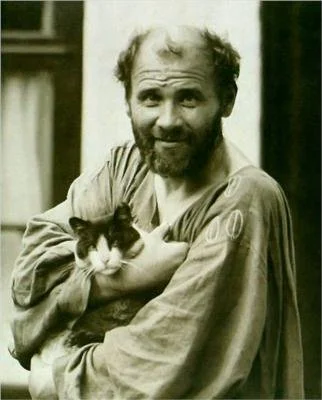
Gustav Klimt was born on July 14, 1862, in Baumgarten, near Vienna, into a modest family. His father, Ernst Klimt, was a gold engraver, a detail that would later resonate symbolically in Klimt’s artistic use of gold leaf. Financial hardship marked his childhood, yet his artistic talent was evident early.
At the age of fourteen, Klimt enrolled in the Vienna School of Arts and Crafts (Kunstgewerbeschule), where he received rigorous academic training. Unlike the avant garde image often associated with him today, Klimt’s early work was firmly rooted in traditional techniques. He excelled in architectural painting, producing decorative murals and ceiling works for public buildings.
Together with his brother Ernst and their colleague Franz Matsch, Klimt formed the “Company of Artists,” undertaking prestigious commissions across the Austro Hungarian Empire. Their work aligned with the expectations of the cultural establishment, historical scenes rendered with technical precision and classical composition.
Klimt’s early success brought recognition and financial stability. He was even awarded the Golden Order of Merit by Emperor Franz Joseph I. At this stage, nothing suggested that he would become a radical force in modern art. Yet beneath the surface, change was brewing.
Crisis and Transformation
The 1890s marked a turning point in Klimt’s life. Personal tragedy struck with the deaths of his father and brother Ernst within a short span. These losses profoundly affected him, both emotionally and artistically. His work began to shift away from conventional narratives toward more introspective and symbolic themes.
At the same time, Klimt grew increasingly dissatisfied with the constraints of academic art. The Künstlerhaus represented a rigid system that stifled innovation. Klimt, along with a group of like minded artists, sought to break free from its authority.
This desire culminated in 1897 with the formation of the Vienna Secession. Klimt became its first president. The Secession was not merely an artistic movement; it was a declaration of independence. Its motto, “To every age its art, to art its freedom,” captured its revolutionary spirit.
The Secessionists rejected historical pastiche in favour of experimentation and international exchange. They drew inspiration from movements such as Art Nouveau and Symbolism, as well as from non-Western art traditions. Their exhibitions introduced Viennese audiences to artists like Vincent van Gogh and Edvard Munch, broadening the city’s artistic horizons. Klimt stood at the centre of this transformation, both as a leader and as an artist, redefining his own practice.
The University Paintings Scandal
Klimt’s break with tradition reached its most dramatic expression in the controversy surrounding his University of Vienna ceiling paintings. Commissioned in the 1890s, the works Philosophy, Medicine, and Jurisprudence were intended to celebrate the triumph of reason and knowledge. What Klimt delivered instead shocked the public.
Rather than depicting orderly allegories of enlightenment, Klimt presented ambiguous, unsettling compositions filled with nude figures, swirling forms, and symbolic imagery. The paintings suggested a world governed not by rational clarity but by instinct, sexuality, and existential uncertainty.
Critics condemned the works as obscene and incomprehensible. The scandal escalated, leading to fierce public debate. Ultimately, Klimt withdrew from the commission, returned the payment, and reclaimed the paintings. This episode marked a decisive rupture. Klimt renounced public commissions altogether, choosing instead to work independently. It was a bold and risky move, but it freed him from institutional constraints and allowed him to pursue his artistic vision without compromise.
The Golden Phase
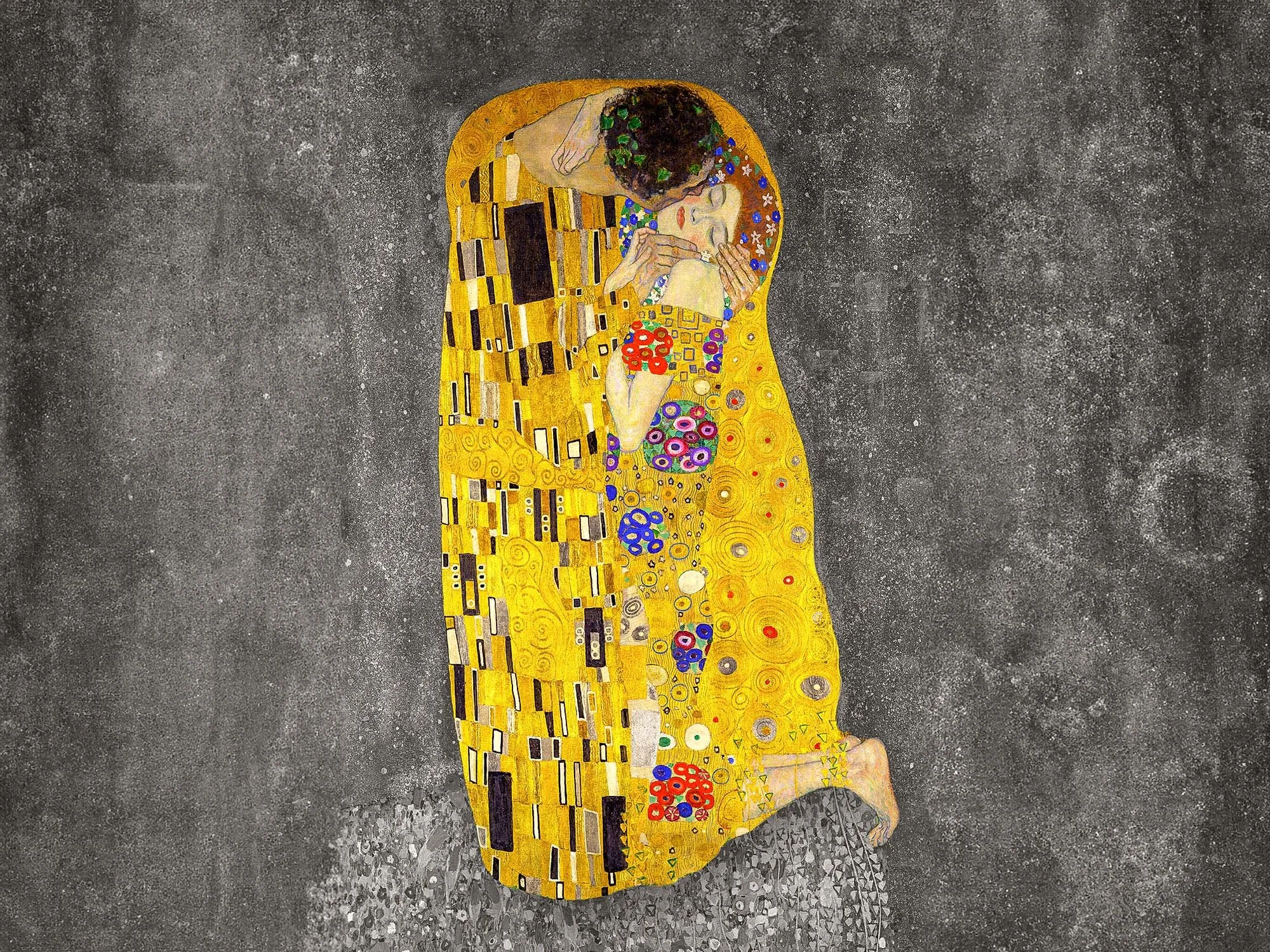
The early 1900s marked the emergence of Klimt’s most celebrated period: the Golden Phase. Inspired in part by Byzantine mosaics he encountered during a trip to Ravenna, Klimt began incorporating gold leaf into his paintings, creating luminous surfaces that blurred the boundary between painting and decorative art.
Works such as The Kiss and Portrait of Adele Bloch Bauer I exemplify this style. Figures are enveloped in intricate patterns, their bodies merging with ornamental fields of gold and color. The effect is both sensuous and transcendent, evoking a timeless, almost sacred atmosphere.
Yet beneath the decorative surface lies psychological complexity. Klimt’s women are not passive subjects; they radiate presence, mystery, and power. His exploration of femininity, often erotic, sometimes unsettling, reflects broader cultural anxieties about gender, sexuality, and identity in fin de siècle Vienna.
Gold, in Klimt’s hands, becomes more than a material. It is a symbol of transformation, elevating the human form into something mythic while simultaneously emphasising its fragility.
Eroticism, Symbolism, and the Feminine
Klimt’s work is inseparable from his exploration of eroticism. His drawings, many of which remained private during his lifetime, reveal a frank and unidealized depiction of female sexuality. These works challenge conventional notions of beauty and morality, presenting desire as a fundamental aspect of human experience.
This focus aligns Klimt with the broader currents of Symbolism, a movement that sought to express inner states rather than external reality. Like Edvard Munch, Klimt used the human body as a site of psychological and emotional expression.
However, Klimt’s approach differs in its emphasis on ornament and sensuality. His compositions often blur the line between figure and ground, suggesting a dissolution of boundaries. This visual strategy mirrors the themes of his work: the merging of self and other, the interplay of life and death, the tension between individuality and unity.
Women occupy a central role in Klimt’s art. They appear as muses, lovers, allegorical figures, and embodiments of abstract concepts. While some critics have interpreted this focus as objectifying, others see it as a radical reimagining of femininity, one that grants women agency and complexity.
Patronage and Society
Klimt’s independence from public commissions did not mean isolation. He cultivated relationships with wealthy patrons, particularly within Vienna’s Jewish bourgeoisie. These patrons provided financial support and allowed Klimt to continue his work without compromise.
Among them was Adele Bloch Bauer, whose portrait became one of Klimt’s most iconic works. The painting exemplifies the intersection of art, wealth, and identity in Vienna at the time. It also carries a poignant historical legacy, having been later seized by the Nazis and eventually restituted after a long legal battle.
Klimt’s studio became a space of artistic experimentation and social interaction. He was known for his unconventional lifestyle, often wearing loose robes and working in an environment filled with models and sketches. Despite his public prominence, he remained a private individual, rarely engaging in self-promotion.
Later Years and Stylistic Evolution
In his later years, Klimt’s style began to evolve once again. While he continued to use decorative elements, his compositions became more fluid and expressive. The influence of younger artists, including Egon Schiele, is evident in his later works.
Klimt maintained a close relationship with Schiele, supporting the younger artist’s career. This mentorship highlights Klimt’s role as a bridge between generations, connecting the decorative elegance of Art Nouveau with the raw intensity of Expressionism.
His later paintings, such as The Bride (left unfinished at his death), suggest a continued exploration of themes related to life, love, and transformation. The decorative surfaces of his Golden Phase give way to a more dynamic interplay of color and form, reflecting an artist still in search of new possibilities.
Death and Legacy
Gustav Klimt died on February 6, 1918, following a stroke and subsequent pneumonia. His death marked the end of an era, coinciding with the collapse of the Austro Hungarian Empire and the profound upheavals of World War I.
Yet Klimt’s influence did not fade. His work continues to resonate across disciplines, inspiring artists, designers, and thinkers. The Vienna Secession’s emphasis on artistic freedom and interdisciplinary exchange remains a cornerstone of modern art.
Klimt’s legacy is multifaceted. He is celebrated as a master of decorative art, a pioneer of Symbolism, and a key figure in the transition to modernism. His exploration of sexuality, psychology, and identity anticipates many of the concerns that would define twentieth-century art.
Perhaps most importantly, Klimt demonstrated that beauty and depth are not mutually exclusive. His work invites viewers to look beyond surface ornamentation and engage with the complexities beneath.
The Enduring Power of Klimt
Gustav Klimt’s life and work embody the paradoxes of modernity. He began as a product of the academic system, yet became one of its most radical challengers. He embraced ornament and decoration, yet infused them with profound symbolic meaning. He depicted beauty, yet confronted the darker aspects of human existence.
In many ways, Klimt’s art mirrors the world he inhabited, a world on the brink of transformation, grappling with uncertainty and possibility. His paintings capture this tension, offering a vision that is both timeless and deeply rooted in its historical moment.
For contemporary audiences, Klimt’s work remains compelling not only for its visual richness but for its emotional and intellectual depth. It speaks to enduring questions about identity, desire, and the nature of art itself.
To engage with Klimt is to enter a space where boundaries dissolve, between figure and ornament, surface and depth, past and present. It is to encounter an artist who understood that art is not merely a reflection of the world, but a means of reimagining it.
And in that sense, Gustav Klimt remains not just a figure of history, but a living presence in the ongoing story of art.
Tate Gustav Klimt Overview
https://www.tate.org.uk/art/artists/gustav-klimt-1426
The Metropolitan Museum of Art Gustav Klimt (1862–1918)
https://www.metmuseum.org/toah/hd/klim/hd_klim.htm
Belvedere Museum Gustav Klimt and the Vienna Secession
https://www.belvedere.at/en/gustav-klimt
MoMA Vienna Secession and Klimt Context
https://www.moma.org/collection/terms/vienna-secession
Guggenheim Museum Klimt Biography and Works
https://www.guggenheim.org/artwork/artist/gustav-klimt
Encyclopaedia Britannica Gustav Klimt Biography
https://www.britannica.com/biography/Gustav-Klimt
The Art Story Gustav Klimt Life Style and Legacy
https://www.theartstory.org/artist/klimt-gustav/
Google Arts and Culture Gustav Klimt Collection and Analysis
https://artsandculture.google.com/entity/gustav-klimt
Victoria and Albert Museum Art Nouveau and Klimt Context
