Eraserhead Explained: David Lynch’s Surreal Horror, Meaning, Themes and Analysis
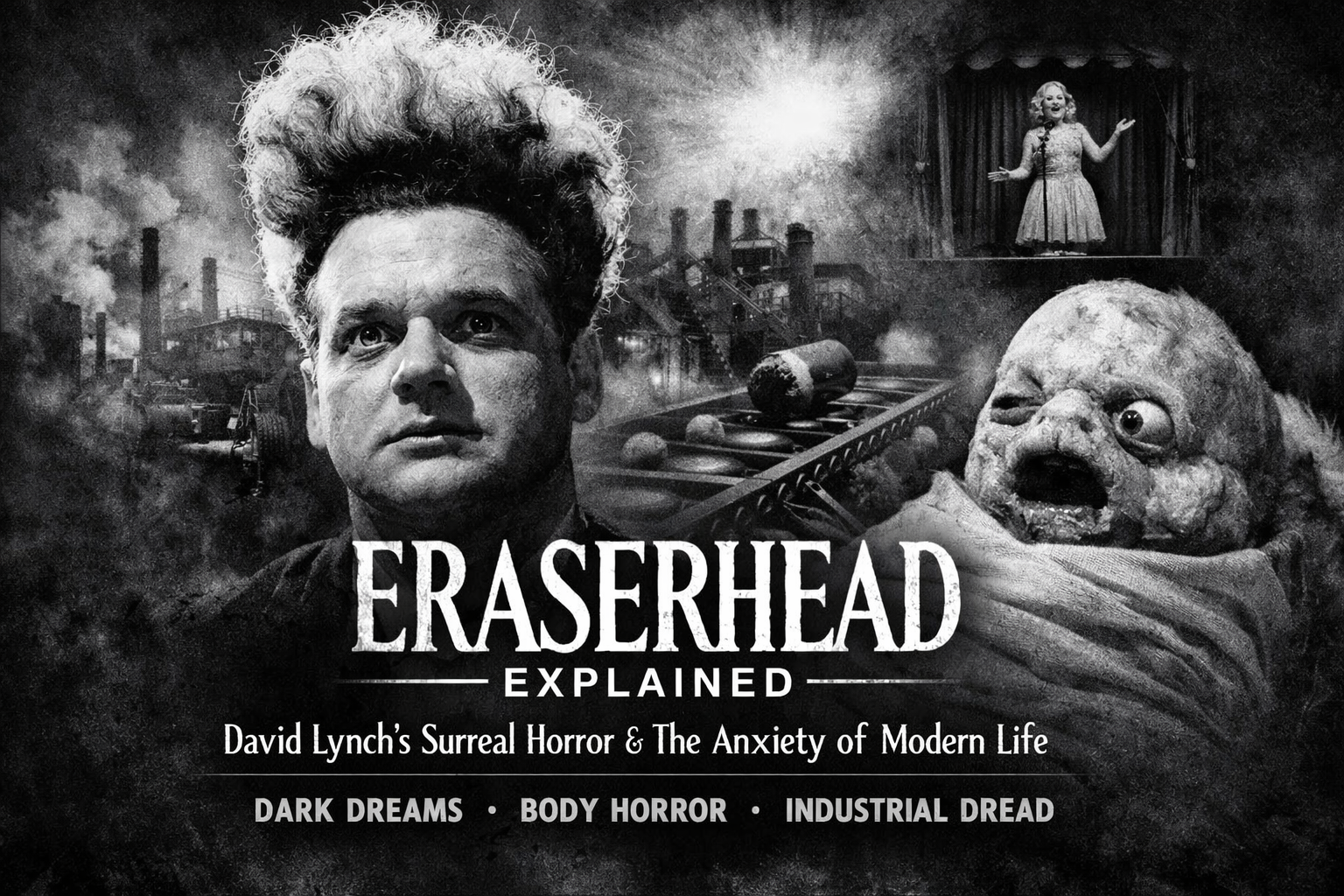
There are films that entertain, films that provoke, and then there are films that seem to emerge from somewhere far deeper, somewhere subterranean, psychological, almost pre-verbal. Eraserhead belongs firmly in that final category. It is not merely watched; it is endured, inhabited, and, for some, survived.
Released in 1977 as David Lynch’s feature debut, Eraserhead stands as one of the most singular works in the history of cinema. Shot over several years on a minimal budget, it is a film that resists conventional interpretation, narrative clarity, and even emotional comfort. Yet its power lies precisely in that resistance. It operates less like a story and more like a dream or, more accurately, a nightmare that refuses to end.
To engage with Eraserhead is to enter a world governed not by logic, but by anxiety, repression, and the strange, oppressive rhythms of modern existence. It is a film about fatherhood, sexuality, industrial decay, and the fragility of the human psyche—but it expresses these themes not through exposition, but through texture, sound, and image.
The Industrial Unconscious
From its opening moments, Eraserhead situates us in a world that feels both external and internal. The film begins with a strange, cosmic image: a floating, expressionless head (Henry’s) drifting against a dark void, accompanied by the unsettling presence of a grotesque figure operating levers inside what appears to be a planetary machine. This is not narrative in any traditional sense. It is symbolic, mythic, almost embryonic.
The world Henry Spencer inhabits is an industrial wasteland anonymous, decaying, suffocating. Smokestacks belch endless fumes. Machinery hums incessantly. The air itself feels thick, contaminated. This is not merely a setting; it is a psychological condition. Lynch’s industrial landscape becomes a manifestation of what might be called the “industrial unconscious” a world in which human beings are reduced to mechanical processes, their inner lives colonised by noise, repetition, and alienation.
In this sense, Eraserhead can be read as a critique of modernity not in a political or overtly ideological way, but in a deeply existential one. The film suggests that something essential has been lost in the transition to an industrialised, technologised society. Human experience has become fragmented, distorted, and estranged from itself.
Henry, with his immobile hair and blank expression, seems less like a fully realised person and more like a vessel a passive observer drifting through a world he cannot understand. He does not act so much as react. Things happen to him. He is caught in a system that operates beyond his control, much like the machinery that surrounds him.
The Body as Horror
At the heart of Eraserhead lies one of the most disturbing images in cinema: the baby. Deformed, fragile, constantly crying, the child is less a character than a presence a living embodiment of anxiety, responsibility, and biological horror. Lynch famously refused to explain how the baby was created, and perhaps that mystery is essential to its power. It feels alien, unknowable, and yet intimately connected to Henry’s own existence.
The baby represents many things at once. It is the terror of parenthood, the fear of inadequacy, the burden of responsibility. It is also the body itself unruly, grotesque, impossible to control. In Eraserhead, the body is not a source of pleasure or vitality, but of discomfort and dread. It leaks, mutates, and suffers.
The dinner scene with Mary’s family is a masterclass in this kind of bodily horror. The tiny chickens on the plate twitch and bleed when cut, collapsing the boundary between food and living organism. Sexuality, too, is rendered strange and unsettling. Mary’s mother’s invasive questioning, her sudden kiss with Henry, and the mechanical awkwardness of Henry and Mary’s relationship all contribute to a sense that human intimacy has become distorted, almost pathological.
Lynch does not present these elements as shocking in a conventional horror sense. There are no jump scares, no dramatic musical cues. Instead, the horror emerges slowly, creeping into the viewer’s consciousness through repetition, discomfort, and the uncanny.
Sound as Atmosphere, Sound as Oppression
One of the most remarkable aspects of Eraserhead is its use of sound. The film’s audio design, created by Lynch and sound designer Alan Splet, is not merely an accompaniment to the visuals, it is a central component of the film’s meaning.
There is almost no silence in Eraserhead. Even in moments of stillness, there is a constant low hum an industrial drone that permeates every scene. This sound functions like a kind of auditory smog, enveloping both the characters and the audience. It creates a sense of unease that is difficult to articulate but impossible to ignore.
The baby’s cries, too, become a form of sonic torture. They are relentless, piercing, inescapable. They transform the domestic space into something oppressive, almost uninhabitable. In this way, sound becomes a tool of psychological immersion. The viewer does not simply observe Henry’s anxiety; they experience it.
The contrast between this oppressive soundscape and the moments of musical relief most notably the appearance of the “Lady in the Radiator,” who sings “In Heaven, everything is fine” is striking. These moments offer a glimpse of escape, a fragile illusion of peace. But they are fleeting, and their artificiality only underscores the impossibility of true relief within this world.
Dream Logic and Narrative Disintegration
To attempt to summarise the plot of Eraserhead is to misunderstand its fundamental nature. The film does not operate according to the rules of conventional storytelling. Events do not follow a clear cause-and-effect logic. Time is fluid. Space is unstable. Characters appear and disappear without explanation.
This is what gives Eraserhead its dreamlike quality. It is structured not as a narrative, but as a series of associations images, sounds, and sensations that flow into one another without clear boundaries. The film mimics the logic of dreams, where meaning is not explicit but symbolic, where emotions take precedence over coherence.
Henry’s head falling off and being turned into erasers is perhaps the most literal expression of this dream logic. It is absurd, surreal, and yet somehow deeply resonant. It suggests a desire to erase oneself, to escape the burden of consciousness, responsibility, and identity.
The film’s climax, in which Henry confronts the baby in a moment of violent breakdown, can be interpreted in many ways. Is it an act of mercy? Of madness? Of liberation? Lynch offers no answers, and that ambiguity is central to the film’s enduring power.
The Anxiety of Fatherhood and Creation
While Eraserhead resists singular interpretation, Lynch himself has hinted that the film is, in part, about the anxiety of becoming a parent. Made during a period in which Lynch had recently become a father under difficult circumstances, the film can be read as an expression of deeply personal fears and uncertainties.
Henry is not prepared for fatherhood. He does not understand the child, cannot care for it properly, and is overwhelmed by its constant demands. The domestic space becomes a site of entrapment rather than comfort. Responsibility is not fulfilling but suffocating.
In this sense, the film touches on something rarely explored in cinema: the darker, more ambivalent aspects of parenthood. It challenges the idealised notion of the family as a source of happiness and stability, instead presenting it as a source of anxiety, confusion, and existential dread.
At a deeper level, this can also be understood as a meditation on creation itself. Just as Henry creates (or participates in the creation of) the child, Lynch creates the film. Both acts involve bringing something into the world that cannot be fully controlled. The artist, like the parent, must confront the limits of their own agency.
Between Horror and Poetry
What ultimately makes Eraserhead so compelling is its ability to exist simultaneously as horror and as poetry. It is a film that disturbs, but also one that mesmerises. Its images linger not because they shock, but because they resonate on a deeper, almost subconscious level.
Lynch’s background in painting is evident in every frame. The film is composed with a meticulous attention to texture, light, and composition. The black-and-white cinematography creates a stark, high-contrast world that feels both timeless and otherworldly.
And yet, for all its darkness, there is something strangely beautiful about Eraserhead. The slow, deliberate pacing, the careful construction of each scene, and the haunting simplicity of its imagery give the film a kind of meditative quality. It invites the viewer not to understand, but to feel.
A Film That Refuses to Leave You
Nearly five decades after its release, Eraserhead remains as unsettling, enigmatic, and powerful as ever. It is not a film that can be easily categorised or explained. It resists closure, interpretation, and comfort.
But perhaps that is precisely why it endures.
In an age of endless content, where films are often designed to be consumed quickly and forgotten just as fast, Eraserhead demands something different. It demands attention, patience, and a willingness to engage with discomfort. It asks the viewer to confront aspects of themselves that are usually hidden fears, anxieties, and the strange, often unsettling realities of being human.
For The Deep Dive Society, a project dedicated to depth in an age of distraction, Eraserhead stands as a kind of cinematic manifesto. It is a reminder that art does not have to be easy to be meaningful. That sometimes, the most important works are the ones that challenge us the most.
To watch Eraserhead is not simply to watch a film. It is to enter a space where the boundaries between reality and dream dissolve, where meaning is elusive, and where the familiar becomes profoundly strange. And once you have entered that space, it is very difficult to leave.
Sources & Further Reading
Primary Work
Eraserhead (1977), directed by David Lynch
A landmark of surrealist and experimental cinema.
Watch via Criterion: https://www.criterion.com/films/28419-eraserhead
Books & Critical Studies
David Lynch: Beautiful Dark — Greg Olson
https://www.amazon.co.uk/dp/0816642249
A detailed biography tracing Lynch’s artistic development and the long creation of Eraserhead.Lynch on Lynch — Edited by Chris Rodley
https://www.faber.co.uk/product/9780571220183-lynch-on-lynch/
A collection of essential interviews offering insight into Lynch’s philosophy and process.The Cinema of David Lynch: American Dreams, Nightmare Visions — Erica Sheen & Annette Davison
https://www.wallflowerpress.co.uk/books/the-cinema-of-david-lynch/
Academic essays exploring Lynch’s themes, aesthetics, and narrative ambiguity.David Lynch — Michel Chion
https://shop.bfi.org.uk/david-lynch.html
A foundational study of Lynch’s cinema, with particular attention to sound and dream logic.
Essays & Film Criticism
British Film Institute
https://www.bfi.org.uk/features/where-begin-david-lynch
Contextual essays on Lynch’s work and cinematic significance.Criterion Collection
https://www.criterion.com/films/28419-eraserhead
Restoration notes, essays, and archival material on Eraserhead.Sight & Sound
https://www.bfi.org.uk/sight-and-sound
Critical retrospectives and long-form analysis of Lynch’s films.
Interviews & Primary Commentary
David Lynch — Interviews (AFI, Criterion, and archival sources)
https://www.afi.com/news/david-lynch-interview/
First-hand reflections on creativity, fatherhood, and the subconscious origins of Eraserhead.
Philosophical & Psychoanalytic Context
The Interpretation of Dreams — Sigmund Freud
https://www.gutenberg.org/ebooks/15489
A foundational text for understanding dream symbolism and unconscious imagery.Carl Jung — Collected works on archetypes and the unconscious
https://press.princeton.edu/books/paperback/9780691150506/the-archetypes-and-the-collective-unconscious
A useful framework for interpreting Lynch’s symbolic and mythic imagery.
