Studio 666’: Foo Fighters' Horror Comedy Examined
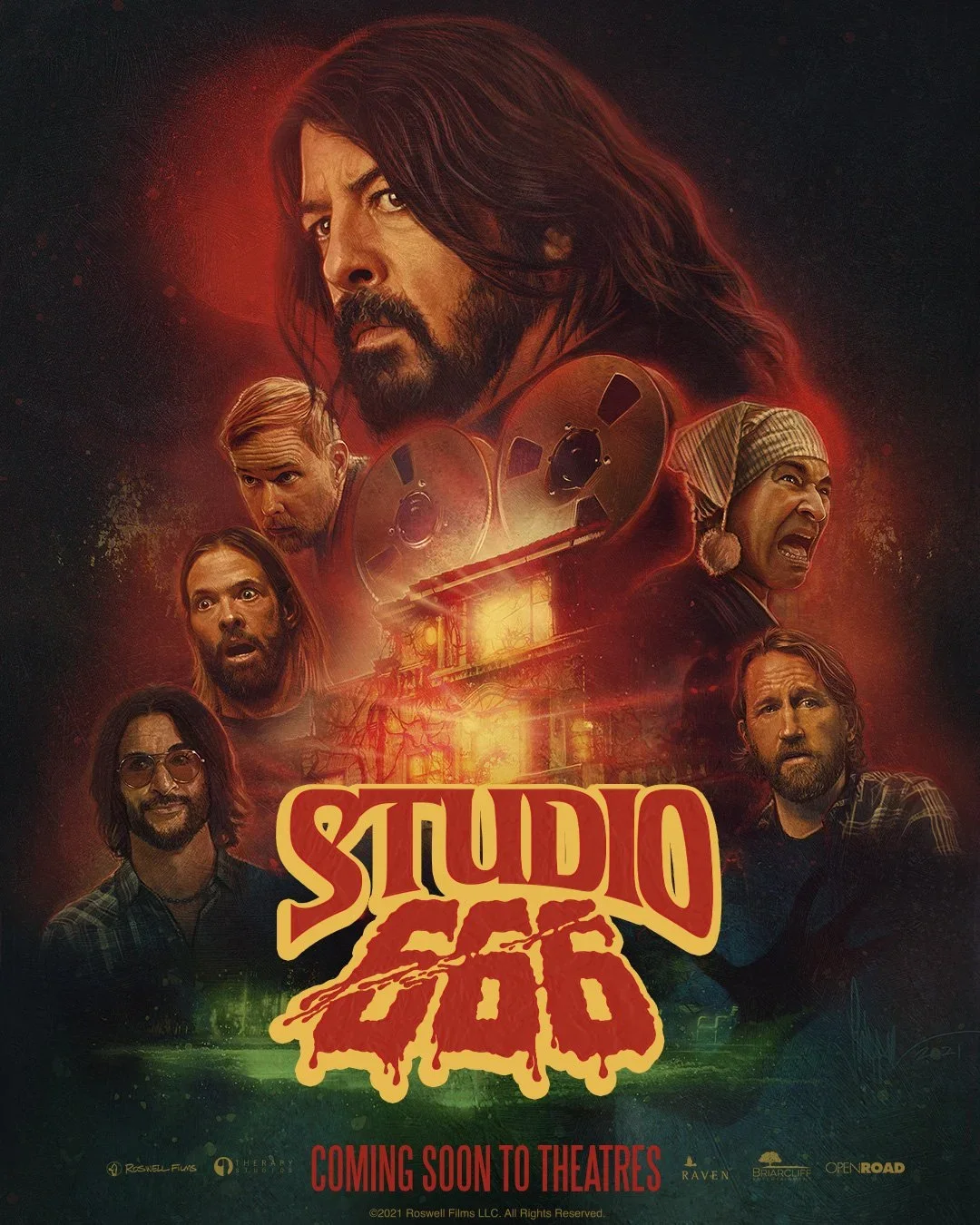
Studio 666 (2022) is a horror-comedy film directed by B. J. McDonnell and written by Jeff Buhler and Rebecca Hughes from a story by musician Dave Grohl. The feature stars the Foo Fighters Dave Grohl, Taylor Hawkins, Pat Smear, Nate Mendel, Chris Shiflett, and Rami Jaffee portraying fictionalised versions of themselves, alongside supporting performances from Whitney Cummings, Leslie Grossman, Will Forte, Jenna Ortega, and Jeff Garlin. Incorporating elements of splatstick gore and self-referential humor, the film draws heavily on low-budget genre traditions and band-centric comedy. With a runtime of approximately 106–108 minutes and marketed as 1 hour and 48 minutes, Studio 666 earned about $3 million worldwide, resulting in a notably underperforming box office outcome.
The film’s premise follows the Foo Fighters as they attempt to overcome creative stagnation while preparing their tenth studio album. At the urging of their record label executive, the band relocates to a mansion in Encino, a property associated with a violent incident involving a 1990s metal group. Soon after arriving, the band encounters a series of disturbances including unusual noises, equipment failures, and unexplained occurrences within the house.
Dave Grohl becomes increasingly fixated on an unfinished composition linked to the mansion’s previous occupants. As recording continues, his behavior grows more erratic, displaying signs of obsession and aggression. He pressures the band to expand the evolving composition into an extended progressive-metal piece. The film escalates from ordinary hauntings to supernatural possession, culminating in graphic and exaggerated death sequences involving both crew and band members.
A plot twist reveals that the record label has been aware of the mansion’s history and has used the property’s supposed curse to generate commercially successful “dark” albums in the past. Grohl’s experiences are shown to align with this pattern. The finale incorporates familiar horror motifs, including exorcism and internal conflict, and concludes with Grohl surviving but seemingly still under the malevolent force’s influence.
The narrative relies on an episodic structure, prioritising set pieces and genre-specific references over character development. McDonnell employs practical gore effects such as decapitations, dismemberment, and other slasher-influenced visuals—echoing the tone of 1980s horror cinema. The film makes extensive use of bright, stylised lighting, including neon and colour gels, lending it a comic-book aesthetic. Editing patterns often resemble music video techniques, with rapid cuts and stylised performance shots.
McDonnell has described Studio 666 as “party horror,” a tone reflected in its combination of jokes and horror elements. Comedic beats frequently interrupt or reframe violent scenes as punchlines. The band members portray exaggerated versions of their public personas, and the screenplay incorporates meta commentary on the creative process, industry expectations, and rock-music stereotypes. While the film’s approach has been compared to works such as Tenacious D in The Pick of Destiny and Evil Dead II, critical reception noted that its comedic and narrative momentum varies, at times resembling a series of loosely connected sketches.
The film’s score was composed by Stone Sour’s Roy Mayorga, with additional contributions from filmmaker and composer John Carpenter, a nod to classic horror traditions. The narrative centres on a fictional “cursed song” written and performed by Dave Grohl, which evolves into a deliberately exaggerated metal composition that recurs throughout the film.
In conjunction with the release of Studio 666, Grohl produced a companion metal album under the fictional band name Dream Widow, further extending the film’s world-building. Among the film’s elements, the music has been noted as one of its strongest components, offering a sound that aligns closely with contemporary metal rather than parody. The score and original recordings reinforce the supernatural storyline and contribute to the film’s tonal identity.
The Foo Fighters appear as fictionalised versions of their real-life personas, delivering performances that reflect their musical backgrounds rather than their training as actors. Dave Grohl assumes the central role, emphasising broad comedic beats and heightened reactions in line with the film’s stylistic approach. The remaining band members—Taylor Hawkins, Pat Smear, Nate Mendel, Chris Shiflett, and Rami Jaffee provide supporting performances that range from intentionally stiff humour to lighthearted exchanges. While some reactions, particularly from Smear and Hawkins, have been highlighted for their comedic timing, overall acting remains limited in range, consistent with the film’s reliance on exaggerated behaviour.
Professional actors, including Whitney Cummings, Will Forte, Jenna Ortega, and Leslie Grossman, appear in supporting roles designed to stabilise scenes or facilitate narrative pacing. Many of these characters serve as catalysts for comedic or horror set pieces. Although these performances add energy, the script generally offers them little depth, limiting their roles primarily to functional or plot-driven moments.
While Studio 666 is not structured as a theme-driven film, several recurring motifs emerge throughout its narrative.
The film’s depiction of a cursed house being exploited by record executives serves as a metaphor for commercial pressures placed on artists. The supernatural element mirrors anxieties surrounding production demands and the expectation to generate marketable content at any personal cost.
Dave Grohl’s increasing possession parallels common descriptions of artistic fixation, amplified into literal demonic control. The storyline reflects concerns about perfectionism, creative burnout, and the toll of sustained productivity.
Some critics, including Peter Bradshaw, have noted that the film’s references to past band tragedies echo real-world events associated with Grohl’s career, particularly the death of Kurt Cobain. These parallels appear unintentional and are not explored in the narrative, yet their presence has been noted as an uncomfortable undertone.
The film incorporates the band’s established public persona, presenting the Foo Fighters as both protagonists and victims in a horror-comedy scenario. This blending of mythology and humour reinforces the group’s image as a self-aware, approachable rock act.
Studio 666 grossed approximately $3 million worldwide during its wide theatrical release, a figure considered low even in niche horror-comedy markets. Multiple outlets, including The Numbers and Forbes, described its performance as a box-office disappointment.
Critical responses were mixed. Genre-specific publications, such as Bloody Disgusting, praised the film’s practical effects and humorous tone, identifying it as entertaining for viewers aligned with its target demographic. Other critics argued that the film felt overlong and uneven, better suited to a limited or festival audience than a full theatrical run.
Mainstream reviewers, including Peter Bradshaw of The Guardian, offered more negative assessments, citing inconsistent humour and tonal imbalance. Audience feedback from PostTrak showed higher approval, with roughly two-thirds of viewers responding positively and nearly half recommending the film.
Studio 666 grossed approximately $3 million worldwide during its wide theatrical release, a figure considered low even in niche horror-comedy markets. Multiple outlets, including The Numbers and Forbes, described its performance as a box-office disappointment.
Critical responses were mixed. Genre-specific publications, such as Bloody Disgusting, praised the film’s practical effects and humorous tone, identifying it as entertaining for viewers aligned with its target demographic. Other critics argued that the film felt overlong and uneven, better suited to a limited or festival audience than a full theatrical run.
Mainstream reviewers, including Peter Bradshaw of The Guardian, offered more negative assessments, citing inconsistent humour and tonal imbalance. Audience feedback from PostTrak showed higher approval, with roughly two-thirds of viewers responding positively and nearly half recommending the film.
The film’s nearly two-hour runtime has been frequently criticised, with reviewers noting pacing issues, extended comedic setups, and repeated gags. The humour is inconsistent, with some scenes resonating while others feel like loosely structured improvisation.
The band’s non-professional acting limits the emotional impact and depth of several scenes, leaving portions of the narrative dependent on gore or genre references to maintain momentum. The film also struggles with tonal cohesion, occasionally juxtaposing lighthearted comedy with darker or more serious material that remains insufficiently integrated into the story.
Viewed through the lens of conventional filmmaking, particularly in terms of narrative cohesion, character development, and tonal balance, Studio 666 presents notable structural weaknesses. Its reliance on genre clichés and prioritisation of band-centred humour may limit its appeal to audiences unfamiliar with the Foo Fighters or the splatstick horror subgenre.
Within the context of cult cinema and rock-horror hybrids, however, the film occupies a more distinctive space. Similar to works such as Kiss Meets the Phantom of the Park, Deathgasm, and Trick or Treat, it offers fans a self-aware, playful entry that blends music culture with horror conventions. Taylor Hawkins’s appearance imbues the film with additional retrospective significance following his passing.
Studio 666 is likely to be most appreciated by fans of the Foo Fighters and viewers who enjoy irreverent, gore-driven horror-comedies. Those seeking a tightly constructed or consistently executed genre film may find it less successful, but as a fan-oriented project, it delivers a uniquely stylised experience.