The Rocky Horror Picture Show: Cult Cinema, Counterculture, and the Art of Becoming.
The Rocky Horror Picture Show: A Cultural Ritual That Refused to Fade
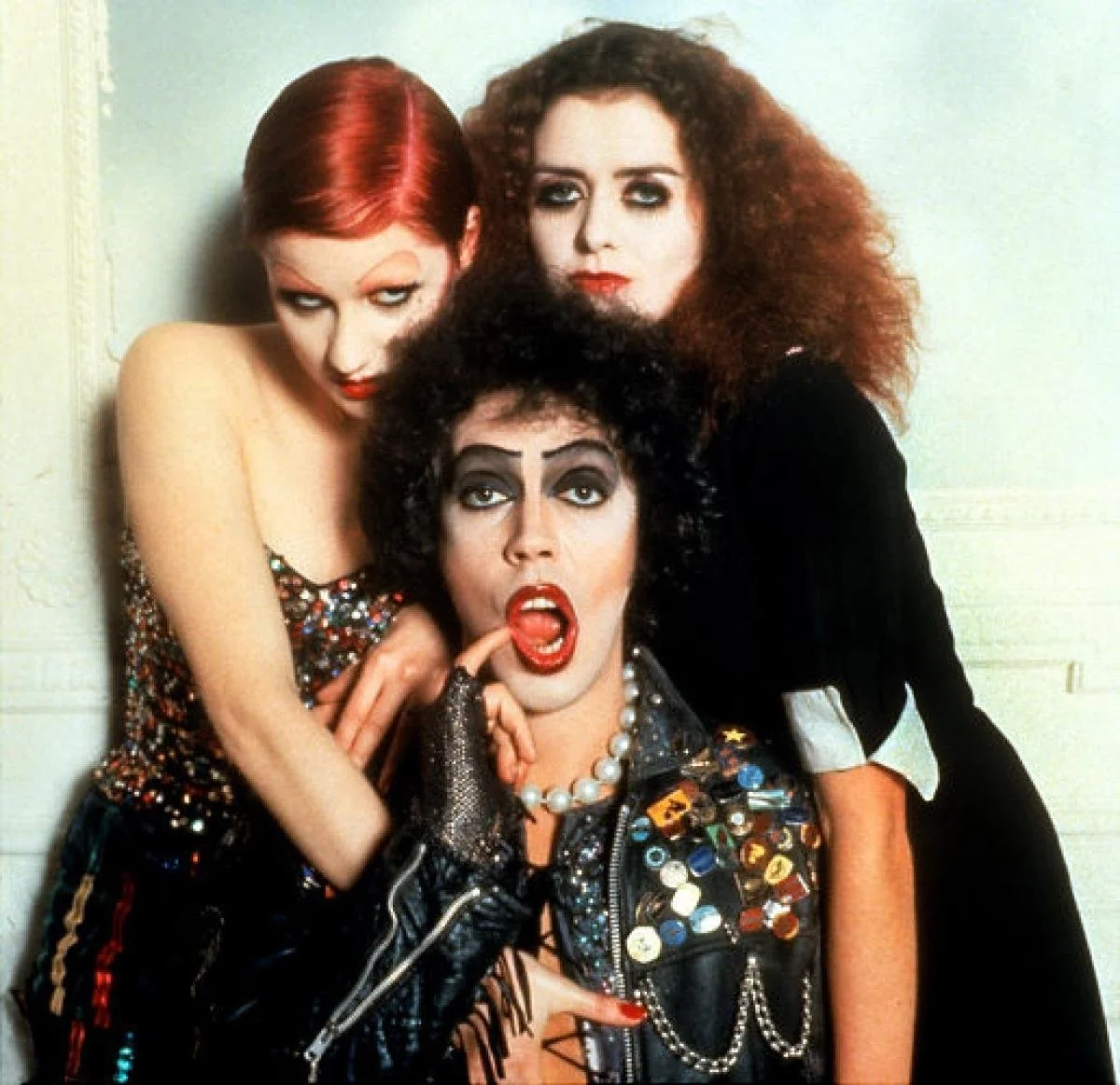
There are films that succeed, films that fail, and films that endure. Then there are those rare works that transform entirely, slipping free from their original form to become something else altogether. The Rocky Horror Picture Show belongs to this last category. It is not simply a film but a phenomenon, not merely a text but a ritual, not only a product of culture but a generator of it.
Released in 1975 to confusion and indifference, it seemed at first to be a minor curiosity, a chaotic blend of genres that resisted easy classification. Yet over time, it would become the longest-running theatrical release in cinema history, a fixture of midnight screenings, and a cornerstone of cult film culture. Its audiences would not merely watch it but inhabit it, responding, performing, and reshaping its meaning through participation.
To trace its history is to examine not only the evolution of a single work but the shifting relationship between art and audience, identity and performance, conformity and rebellion. It is to confront the question of how something initially rejected can become essential.
Before the Film: Cultural Conditions and Creative Origins.
The origins of The Rocky Horror Picture Show lie in a specific cultural moment. The early 1970s were marked by a fragmentation of identity and aesthetic experimentation. Traditional social structures were being questioned, while artistic movements pushed against established norms. Glam rock, in particular, introduced a new kind of performative identity, one that embraced theatricality, ambiguity, and transformation.
Within this context, Richard O'Brien conceived The Rocky Horror Show. Drawing on his own experiences of alienation and creative frustration, he constructed a work that was both deeply personal and broadly referential. It was a collage of influences: horror films of the 1930s, science fiction narratives of the 1950s, and the flamboyant energy of contemporary music culture.
The production debuted at the Royal Court Theatre in London in 1973, in a small upstairs space that encouraged intimacy and experimentation. It was not designed for mass appeal. Its humour was eccentric, its narrative fragmented, its tone unstable. Yet these qualities became its strength. The show attracted an audience that recognised itself within its strangeness.
At the centre of this universe was Frank N Furter, portrayed by Tim Curry. This character encapsulated the ethos of the work: fluid, theatrical, transgressive. Frank did not conform to traditional categories of gender or morality. Instead, he embodied a radical form of self creation, one that would resonate deeply with audiences seeking alternatives to conventional identity.
The success of the stage production was not immediate but cumulative. It grew through word of mouth, through repeated attendance, through the gradual formation of a community. This pattern would later repeat itself on a much larger scale.
Adaptation and Release: The Failure That Made It Possible
The transition from stage to screen was driven by a combination of ambition and opportunity. Backed by 20th Century Fox and directed by Jim Sharman, the film sought to preserve the spirit of the original production while expanding its visual scope. Yet the very qualities that made the stage show compelling became liabilities in a cinematic context. The film’s refusal to adhere to genre conventions, its overt sexuality, and its camp aesthetic alienated mainstream audiences. Critics struggled to interpret it, often dismissing it as incoherent or indulgent.
The mid 1970s were not a hospitable environment for such a work. Cinema was undergoing a transformation, with a focus on realism and psychological depth. Against this backdrop, The Rocky Horror Picture Show appeared frivolous, even regressive.Its commercial failure was swift. Screenings dwindled. It seemed destined to vanish.But failure, in this case, created the conditions for reinvention. Without the pressures of mainstream success, the film was free to find its own audience.
Midnight Movies: The Birth of a New Form of Engagement
The revival of The Rocky Horror Picture Show began in the margins. Midnight screenings, particularly in urban centres, provided a space for films that did not fit conventional programming. It was within this context that Rocky Horror found its audience.
At the Waverly Theater in New York, repeated screenings attracted viewers who returned again and again. This repetition fostered familiarity, and familiarity encouraged participation. Audiences began to interact with the film, initially in small ways, then with increasing complexity.
They spoke back to the screen, creating a dialogue that transformed the viewing experience. They introduced props, synchronising their actions with specific scenes. They dressed as characters, blurring the line between spectator and performer.
This process was not orchestrated. It emerged organically, driven by the audience’s desire to engage more deeply with the film. Over time, these practices became codified, forming a shared language of participation.
The emergence of shadow casts formalised this interaction. Performers would act out the film in front of the screen, creating a layered experience that combined cinema and live theatre. The film became a script, a framework for performance.
This transformation redefined the relationship between art and audience. The film was no longer a fixed object but a dynamic event.
The Cult Film: Redefining Success and Meaning
The Rocky Horror Picture Show did not simply become popular. It redefined what popularity could mean. A cult film is sustained by devotion rather than mass appeal. Its audience is not passive but active, not casual but committed. It thrives on repetition, reinterpretation, and communal experience. Rocky Horror established the template for this form of engagement. It demonstrated that a film could achieve longevity not through initial success but through sustained interaction. Its influence can be seen in later works that developed dedicated followings, yet none have replicated its participatory intensity. Rocky Horror remains singular in its ability to transform spectators into collaborators.
Genre and Form: Aesthetic Hybridity as Identity
One of the defining features of The Rocky Horror Picture Show is its refusal to conform to a single genre. It combines elements of horror, science fiction, comedy, and musical theatre, creating a hybrid form that resists categorisation.
This hybridity is not merely stylistic but thematic. The film’s blending of genres mirrors its exploration of identity. Just as it refuses to be defined by a single aesthetic, it challenges rigid notions of gender, sexuality, and morality.
The musical elements are central to this dynamic. Songs function not only as narrative devices but as points of entry for audience participation. They create moments of collective experience, transforming the film into a shared performance.
Identity and Transformation: The Politics of Performance
At its core, The Rocky Horror Picture Show is about transformation. It presents identity as something fluid, performative, and open to reinvention.
Brad and Janet begin as embodiments of conventional normality. Their journey into the world of Frank N Furter represents a confrontation with alternative modes of existence. Through this encounter, their identities are destabilised and reconfigured.
The film challenges binary thinking. It rejects fixed categories, embracing instead a spectrum of possibilities. This perspective was particularly significant in the context of the 1970s, when discussions of gender and sexuality were often constrained by rigid norms.
For many viewers, the film provided a space of recognition and validation. It offered an alternative vision of identity, one that celebrated difference rather than suppressing it.
Cultural Impact: From Subculture to Mainstream Influence
Over time, the influence of The Rocky Horror Picture Show extended beyond its immediate context. Its aesthetic and ethos permeated various aspects of culture, from fashion to performance art.
It played a role in the visibility of gender nonconformity and the normalisation of alternative identities. Its emphasis on performance and self expression resonated with broader cultural movements, contributing to a shift in how identity was understood and represented.
The film also anticipated the rise of fan culture. It demonstrated how audiences could organise, create traditions, and sustain a work of art through collective engagement.
Endurance and Legacy: A Living Cultural Form
The continued relevance of The Rocky Horror Picture Show lies in its adaptability. It is not tied to a specific moment but continually reinterpreted by new audiences.
Midnight screenings persist, drawing participants who contribute their own interpretations and practices. The film remains a site of communal experience, a space where individuals can express themselves freely.
Its legacy is not static but evolving. Each performance, each screening, adds to its history.
Becoming the Work
The Rocky Horror Picture Show challenges conventional ideas of what a film can be. It is not merely something to be watched but something to be enacted.
Its journey from failure to phenomenon reveals the power of audiences to shape cultural meaning. It demonstrates that art is not fixed but dynamic, not isolated but communal.
In the end, its most enduring message is one of possibility. It invites its audience to step beyond the boundaries of convention and to embrace the act of becoming.
