Moonage Daydream Review
There is a particular kind of artist whose life resists documentation. Not because the archive is lacking, but because the archive is too abundant, too fluid, too deliberately constructed. David Bowie is one such figure. Across five decades he did not simply produce music, images, and performances; he produced selves. Each persona was both revelation and concealment, each transformation an act of artistic creation that blurred the boundary between life and work. To approach Bowie, then, is not merely to tell a story. It is to enter a shifting field of identities, symbols, and sounds that refuse to settle into a single narrative.
It is precisely this challenge that Brett Morgen embraces in Moonage Daydream. Rather than attempting the impossible task of definitive biography, Morgen constructs something far more ambitious: a cinematic experience that mirrors Bowie’s own artistic logic. The film does not explain Bowie. It inhabits him.
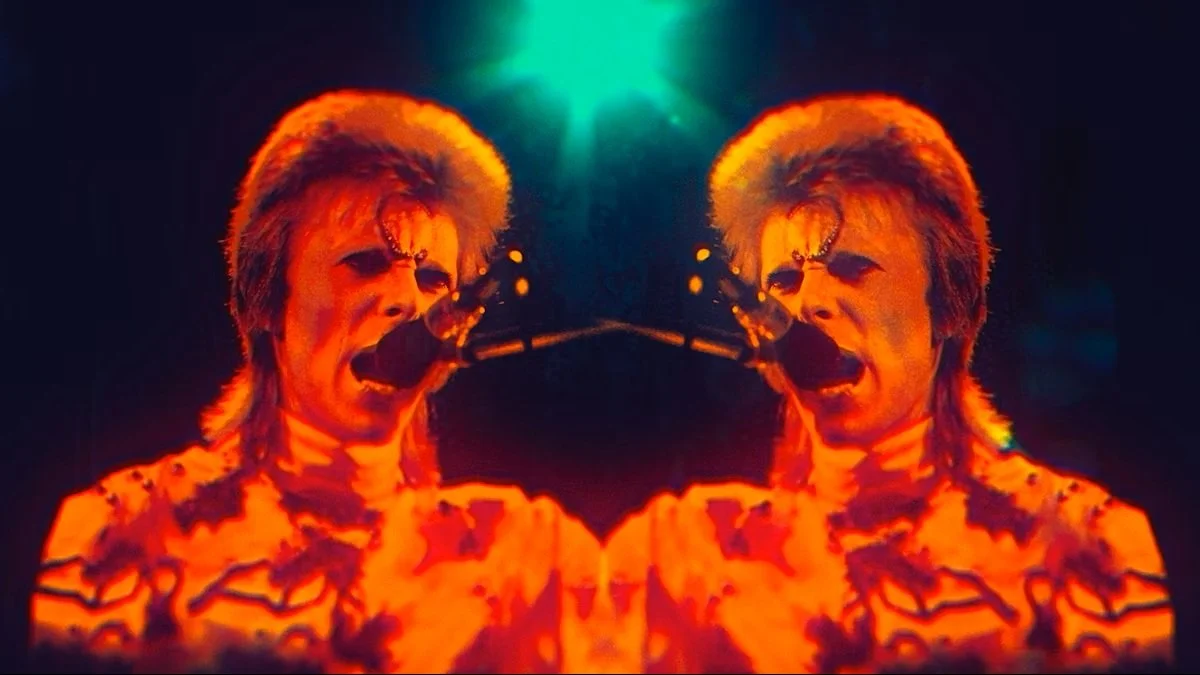
From its opening moments, Moonage Daydream establishes its refusal of convention. There are no talking heads, no authoritative narrators, no linear progression from childhood to canonisation. Instead, Morgen draws exclusively on Bowie’s own words, interviews, performances, and archival materials, weaving them into a dense audiovisual tapestry. The result is less a documentary than an environment. You do not watch it so much as enter it.
This decision aligns with a broader question at the heart of The Deep Dive Society’s approach to culture: how should we represent an artist whose work is fundamentally about transformation? A chronological account risks reducing Bowie to a sequence of eras. Morgen instead offers something closer to what might be called “deep listening in cinema” a mode of engagement that privileges immersion over explanation, experience over summary.
The film’s editing is central to this effect. Images collide, dissolve, and reconfigure in rapid succession. Concert footage bleeds into experimental visuals, interviews fragment into poetic monologues, and moments from different decades are juxtaposed without warning. Yet this apparent chaos is carefully composed. Morgen’s montage follows an associative logic, one that echoes Bowie’s own methods of composition, from cut-up lyric writing to genre hybridisation. Meaning emerges not through exposition, but through rhythm, contrast, and accumulation.
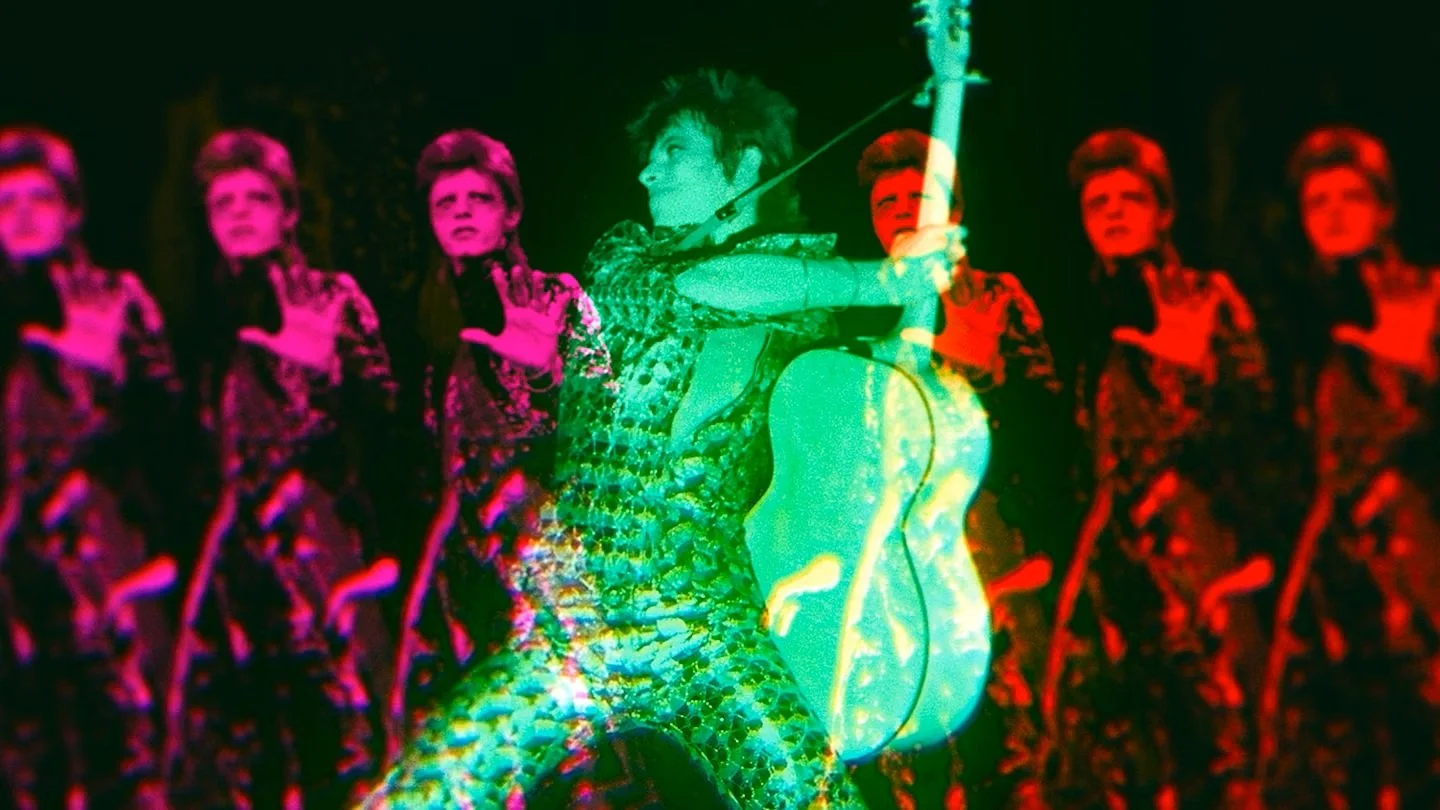
This is not without risk. Viewers accustomed to traditional music documentaries may initially find themselves disoriented. There is no clear timeline to hold onto, no guiding voice to anchor interpretation. But it is precisely in this disorientation that the film finds its power. Bowie’s career was defined by the destabilisation of identity, the refusal of fixed meaning. Moonage Daydream invites the audience to experience that instability rather than merely hear about it.
Sound, unsurprisingly, is the film’s most potent force. The soundtrack is expansive, moving fluidly between iconic recordings and less familiar material, each track recontextualised through its placement within the film’s audiovisual architecture. Songs are not presented as isolated performances but as emotional and philosophical nodes within a larger network. A familiar chorus can suddenly feel strange again, refracted through new imagery, new juxtapositions, new emotional registers.
For longtime listeners, this approach offers the rare experience of rediscovery. Deep cuts and alternative takes disrupt the canon, reminding us that Bowie’s catalogue is not a fixed monument but a living archive. For newcomers, the effect is perhaps even more profound. Stripped of chronological framing, Bowie emerges not as a historical figure to be learned, but as a presence to be encountered.
Yet Moonage Daydream is not simply an aesthetic experiment. Beneath its sensory intensity lies a sustained meditation on identity, creativity, and the conditions of modern life. Bowie speaks frequently, and often candidly, about the construction of self. Fame, in his account, is both liberating and imprisoning. The persona becomes a tool, a mask, a shield, and eventually, a problem. Who are you when the world insists on seeing only your creation?
Morgen does not resolve this tension, nor could he. Instead, he allows it to resonate across the film’s structure. The constant shifting of image and sound becomes a formal expression of Bowie’s philosophical concerns. Identity is not stable. Meaning is not fixed. The self is something that must be continually made and remade.
In this sense, the film extends beyond the domain of music documentary into something closer to visual philosophy. It asks questions rather than delivering answers. What does it mean to live creatively in a world that demands coherence? How do we remain open to change without losing ourselves entirely? And what is the role of the artist in an age saturated with images, information, and spectacle?
These questions feel particularly urgent now. In a cultural landscape dominated by algorithms, branding, and rapid consumption, Bowie’s commitment to reinvention reads as both inspiration and challenge. He refused to become static, even when stability would have guaranteed success. He embraced risk, ambiguity, and contradiction. He treated identity not as a given, but as an ongoing project.
Morgen’s film honours this ethos by refusing to simplify it. There is no attempt to reduce Bowie to a set of defining traits or to resolve the contradictions that defined his career. Instead, Moonage Daydream preserves the complexity, the strangeness, and the openness that made Bowie who he was. It is, in this sense, an ethical work as much as an aesthetic one.
The result is a film that feels less like a retrospective than an encounter. It does not close Bowie’s story; it reopens it. By resisting the conventions of biography, Morgen allows Bowie to remain what he always was: elusive, mutable, and alive in the act of becoming.
For The Deep Dive Society, this is perhaps the film’s greatest achievement. It embodies a mode of cultural engagement that refuses the surface in favour of depth, that privileges experience over summary, and that understands art not as content to be consumed, but as a field to be entered. Moonage Daydream does not tell us who David Bowie was. It invites us to experience how he thought, how he created, and how he transformed.
In doing so, it offers something increasingly rare in contemporary media: not information, but immersion. Not certainty, but possibility.
And in that space, Bowie remains what he has always been not a fixed icon, but a question.